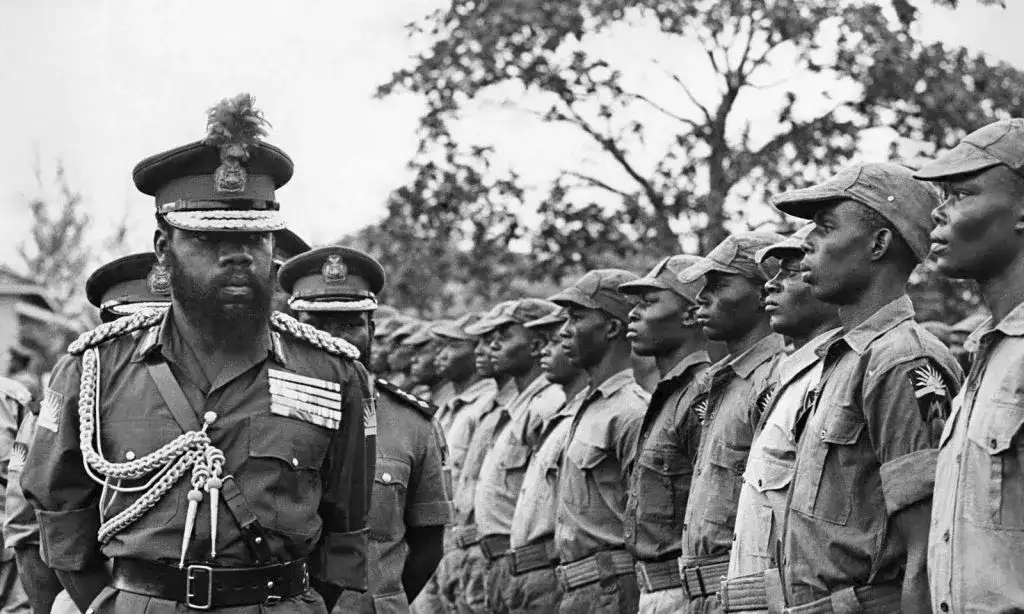
Imagine waking up as a teenager in Lagos to find part of a crashed warplane in your backyard without hearing a sound. That haunting memory has stayed with Dorothy Davis for over five decades, a personal reminder of the chaos of the Nigerian Civil War.
Now, years later, Dorothy has returned to Nigeria to honour her late father, Griffith J. Davis, whose work captured some of the most defining moments in African history. Though he served officially as a communications officer during his time in Nigeria from 1966 to 1971, his deeper legacy lies in the powerful photographs he left behind.
At an exhibition held at Freedom Park in March 2026, Dorothy showcased selected images from her father’s vast archive of over 55,000 photographs. The exhibition, titled Towards Freedom and Independence Across the Diaspora, offered rare visual insights into historical events that shaped Nigeria and the African continent.
Among the highlights were early images of Nnamdi Azikiwe and Kwame Nkrumah, alongside a controversial photograph capturing Richard Nixon meeting Martin Luther King Jr. during Ghana’s independence era. These images, many unseen for decades, offer a fresh perspective on well-known historical figures.
Dorothy’s return was also tied to her participation in the 89th birthday celebration of Olusegun Obasanjo in Abeokuta. Seizing the moment, she used the visit to reconnect Nigeria with a visual history that has long remained hidden.
Beyond politics, the photographs reveal everyday realities of wartime Nigeria: darkened cities, military checkpoints, and moments of quiet fear like the unexplained appearance of aircraft debris in residential spaces. Through his lens, Griffith documented not just events, but emotions and lived experiences.
For Dorothy, preserving and sharing this archive is a mission. With only a fraction of the collection processed, she hopes these images will educate younger generations and fill gaps left by traditional historical narratives.
“These are stories not always found in textbooks,” she says, reflecting on a legacy that continues to bridge continents, memory, and identity.







Leave a comment