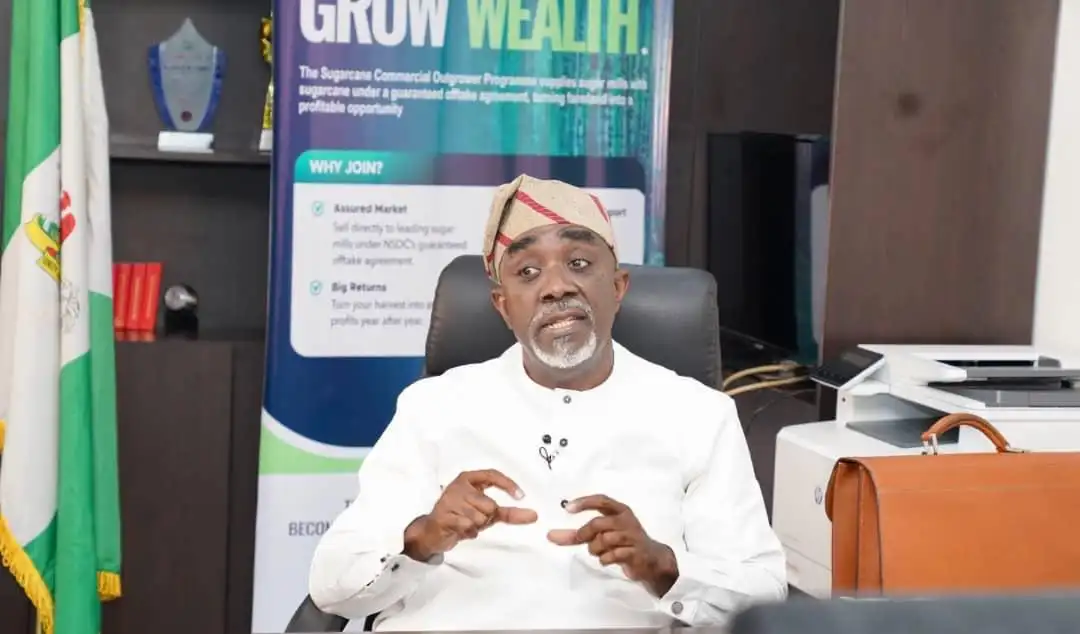
As Nigeria intensifies efforts to achieve self-sufficiency in sugar production, greenfield sugar projects have emerged as a cornerstone of the country’s strategy to close its widening supply gap. The Executive Secretary and Chief Executive Officer of the National Sugar Development Council (NSDC), Mr Kamar Bakrin, says recently signed Memoranda of Understanding with investors mark a turning point for the sector.
According to Bakrin, the four greenfield projects backed by credible promoters are expected to significantly boost local output. When fully operational, they are projected to add about 400,000 metric tonnes of sugar annually, helping to reduce Nigeria’s heavy reliance on imports. Beyond output, the projects are designed as fully integrated operations, combining large-scale sugarcane farming with modern processing facilities.
He noted that the geographic spread of the projects across the South-West, North-Central and North-East would allow Nigeria to leverage diverse agro-climatic conditions while ensuring that benefits such as employment, infrastructure and enterprise development are widely shared.
One of the flagship investments is the GNAL Sugar project promoted by the Lee Group in Taraba State. Bakrin said the project is progressing steadily, having moved beyond expressions of interest into concrete planning stages. Several local government areas have already been identified for cultivation and processing, while work continues on land access, site selection and project definition.
Taraba State, he explained, emerged after a rigorous nationwide assessment due to its abundant land, reliable water resources and favourable agro-climatic conditions for sugarcane cultivation. Equally important was the strong commitment shown by the state government, a critical factor for the success of large-scale agro-industrial projects that require close collaboration among investors, communities and public authorities.
Addressing concerns around the availability of quality planting materials, Bakrin said NSDC is tackling the challenge through a multi-layered approach. Dedicated seedcane farms have been elished to support greenfield projects and reduce dependence on imported materials. In addition, the Nigeria Sugar Institute (NSI) is deploying pre-sprouted bud set technology, which accelerates the multiplication of healthy planting materials, reduces development timelines and lowers costs.
Bakrin also clarified misconceptions about the Nigeria Sugar Institute, describing it as a purpose-built national institution serving as the research, training and technical backbone of the sugar industry. Elished in 2019 and commissioned in 2021, NSI operates under NSDC’s strategic oversight, with facilities in Ilorin supporting varietal development, tissue culture and applied research for industry-wide benefit.
Two years into his tenure, Bakrin said NSI has undergone significant reforms. Governance and operating frameworks have been strengthened with professional support, staff capacity has been upgraded, and the institute has been repositioned as a national hub for practical, industry-focused training through the NSDC/NSI Boot Camp initiative. These reforms, he said, are laying the foundation for NSI to function as a credible centre of excellence.
Another major intervention is the Sugarcane Outgrower Development Programme, which aims to integrate farmers more effectively into the sugar value chain. Bakrin said feedback has been overwhelmingly positive, with strong interest from farmers, cooperatives and agribusinesses, particularly in communities near existing sugar estates. The programme links farmers directly to licensed processors through guaranteed offtake arrangements, while also providing access to quality inputs, training and extension services.
On large-scale investments, Bakrin described the $1bn partnership between NSDC and SINOMACH as a major inflection point for the sector. The agreement is expected to unlock capacity for up to 500,000 metric tonnes of sugar annually, bring about 75,000 hectares under cultivation and add significant processing capacity. Beyond production figures, he said the partnership would drive job creation, conserve foreign exce and strengthen Nigeria’s long-term food security.
While acknowledging the scale of ambition, Bakrin expressed confidence in delivery timelines, noting that NSDC has prioritised early resolution of common bottlenecks such as land access, regulatory approvals and community engagement. With groundwork already laid and stakeholder alignment achieved, he said the council is well-positioned to move decisively from preparation to execution in Nigeria’s quest for sugar self-sufficiency.










Im not convinced that greenfield sugar projects alone can make Nigeria self-sufficient. We need a comprehensive approach.
Im not convinced that greenfield sugar projects alone can solve Nigerias self-sufficiency drive. More factors need consideration.
Do you think greenfield sugar projects are truly the answer to Nigerias self-sufficiency goals, or is there a better approach?
Im not convinced that greenfield sugar projects alone can make Nigeria self-sufficient. We need a holistic approach.
This article overlooks the environmental impact of greenfield sugar projects in Nigeria. Are we sacrificing sustainability for self-sufficiency?
Do greenfield sugar projects truly benefit local communities or just big corporations? Lets discuss! 🌿🤔 #SustainabilityDebate
I disagree with the focus on greenfield sugar projects – what about supporting local farmers instead? Lets prioritize sustainability over new developments.
Im not convinced greenfield sugar projects are the answer. What about sustainable alternatives like promoting local fruit production?
Im not convinced that greenfield sugar projects alone can make Nigeria self-sufficient. There are many factors at play here.