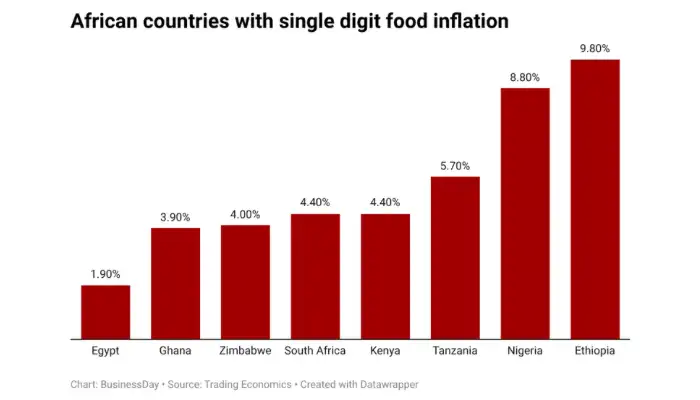
The latest projections from the Food and Agriculture Organization, analyzed by Visual Capitalist, reveal sharp contrasts in expected food inflation across 160 countries in 2026, with African economies dominating both the highest increases and some of the steepest declines.
While advanced economies are forecast to see moderating or declining food prices, inflationary pressures are expected to remain concentrated in emerging and import dependent markets, particularly across Africa. The report ranks countries by projected year over year food price ces, highlighting where households are likely to face the greatest cost pressures.
Nigeria is projected to record the highest food inflation at 17.1 percent, driven by import dependence, currency pressures, and supply chain challenges affecting domestic food availability. Angola follows with an expected 14.8 percent increase due to exce rate volatility and reliance on imports.
Other African countries in the top ten for projected food inflation include Zambia at 10.8 percent, Ethiopia at 10.1 percent, Burundi at 8.8 percent, Cabo Verde at 7.2 percent, Cameroon at 7.0 percent, Kenya at 6.8 percent, Somalia at 6.7 percent, and Tanzania also at 6.7 percent.
The report attributes these trends to a combination of factors, including currency weaknesses, supply chain disruptions, elevated input costs, weather variability, and domestic agricultural limitations. Island nations such as Cabo Verde remain particularly vulnerable to global food price shocks due to their reliance on imports.
These projections underscore the challenges that African households are likely to face in 2026, highlighting the need for targeted interventions to improve food security and reduce the impact of inflation on vulnerable populations. Policymakers are urged to strengthen domestic production, ilize currencies, and enhance supply chain resilience to mitigate the effects of rising food costs.













Leave a comment