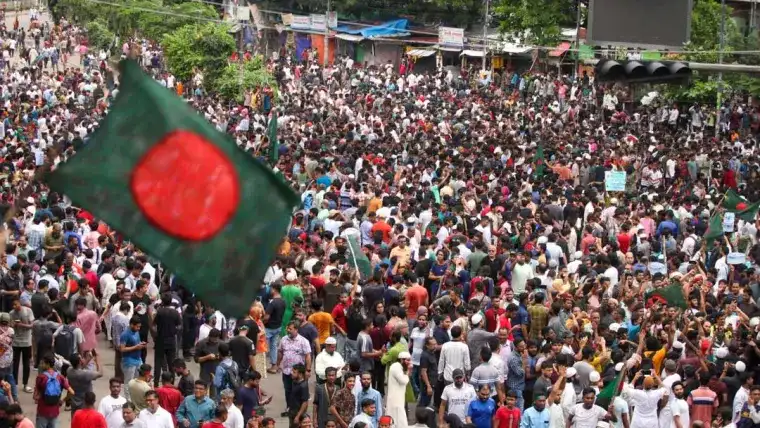
A subtle but powerful political shift is unfolding in Bangladesh, and it is beginning to ripple far beyond its borders. Recent reports suggest that the United States may be exploring c engagement with Jamaat e Islami, the country’s most prominent Islamist political party, at a moment when the group appears poised for its strongest electoral performance in years. What looks like a diplomatic adjustment could soon evolve into a geopolitical dilemma with consequences for South Asia and beyond.
According to information revealed through interactions between an American diplomat and Bangladeshi journalists in Dhaka, Washington is closely watching the rise of Jamaat e Islami ahead of the upcoming national elections. The diplomat reportedly acknowledged that Bangladesh is experiencing a noticeable shift toward religious political influence and indicated that the United States is interested in building channels of communication with Jamaat leaders.
Although the American embassy later clarified that the discussion was informal and that the United States does not officially support any political party, the message was difficult to ignore. Analysts say it reflects a growing recognition in Washington that Jamaat e Islami has become too influential to be sidelined in future political calculations.
For decades, Jamaat e Islami has occupied a controversial position in Bangladesh’s political landscape. Long criticised for its stance during the country’s liberation struggle and repeatedly banned from politics, the party has worked to reinvent itself in recent years. Following the political upheaval that led to the removal of the previous government in 2024, Jamaat began reshaping its public image, focusing on anti corruption messages and social welfare initiatives to attract broader support.
Opinion polls and political trends suggest that this strategy is working. Surveys indicate that Jamaat could emerge as one of the most competitive forces in the upcoming election, trailing closely behind the main opposition party. Its student wing has also gained significant influence in universities, signalling growing grassroots support and expanding political reach.
Yet this rising influence is not without controversy. Jamaat e Islami has historically promoted conservative religious policies and has been associated with calls for governance rooted in religious law. While the party has recently softened its rhetoric, many observers remain skeptical about its long term intentions. Minority communities and moderate groups in Bangladesh have expressed concern that Jamaat’s ascent could alter the country’s social and political fabric.
The United States appears to be walking a delicate line. On one hand, engaging Jamaat could help Washington maintain influence in a rapidly cing political environment. On the other hand, such engagement risks alienating key allies, particularly India, which views Jamaat’s ideological leanings and its historical ties with Pakistan with deep suion.
Reports suggest that American officials believe they still hold significant economic leverage over Bangladesh. The garment industry, which plays a crucial role in the country’s economy and exports to the United States, remains a powerful tool of influence. US officials have reportedly warned that any move toward restrictive social policies or religious authoritarianism could trigger severe economic consequences.
This emerging dynamic reveals a deeper reality about global politics. Ideology, economics, and strategic interests are increasingly intertwined, and major powers are willing to engage with unlikely partners when it serves their long term goals. For Bangladesh, the rise of Jamaat e Islami represents both a political transformation and a test of its democratic identity. For the United States, it is a strategic gamble. For India, it is a potential security and diplomatic challenge.
As the election approaches, Bangladesh stands at a critical moment. The choices made by its voters and the responses of global powers could reshape not only its domestic politics but also the balance of influence across South Asia. What is happening quietly in Dhaka today may soon echo loudly across international diplomacy.








Is this quiet shift in Bangladesh really going to shake global alliances or is it just another overhyped headline? What do you think?
I wonder if this shift in Bangladesh will really have a big impact on global alliances. Its like a game of political chess!
Who knew Bangladesh could have such a big impact on global alliances? This quiet shift is definitely soing to keep an eye on!
Did you guys read about the shift in Bangladesh? What do you think this means for global alliances? Im curious!
Im not sure if this quiet shift in Bangladesh will really shake global alliances. What do you guys think? Interesting times ahead!
Do you think Bangladeshs cing alliances will impact global politics? Its like a game of chess with unpredictable moves!
Do you think Bangladeshs shift in alliances will have a big impact globally or is it just a small ripple? 🤔 #GlobalPolitics
Do you think Bangladeshs quiet shift will really shake global alliances or is it just a temporary blip? Curious to hear your thoughts!
Do you think this shift in Bangladesh will actually have a major impact on global alliances? Im curious to hear different perspectives on this.