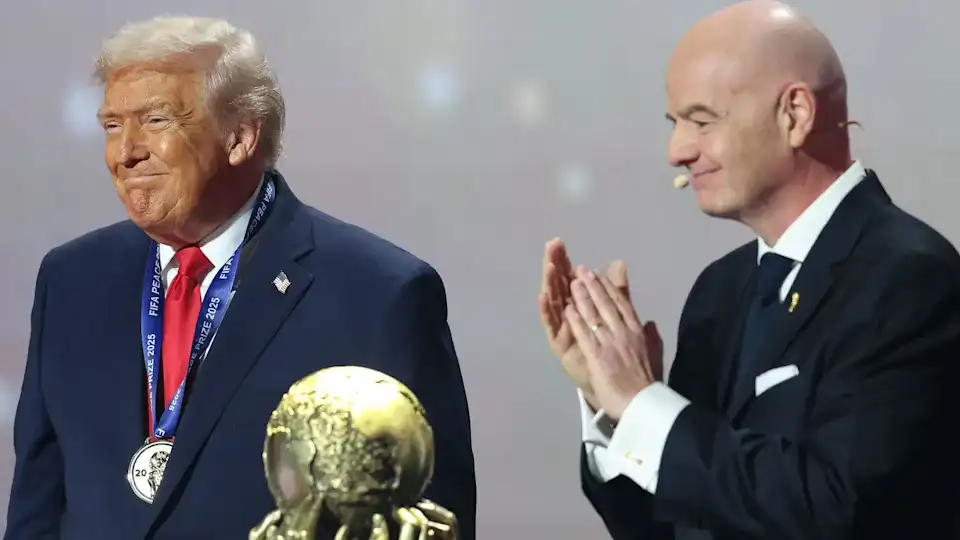
In a controversial decision, FIFA President Gianni Infantino awarded the inaugural FIFA Peace Prize to former U.S. President Donald Trump during the 2026 World Cup draw in Washington, D.C. This move has drawn widespread criticism and raised questions about FIFA’s commitment to political neutrality and award integrity.
Launched in November 2025, the FIFA Peace Prize aims to honor individuals who promote peace and unity through football. However, many view Trump’s selection as the first recipient with skepticism, suspecting it aligns FIFA with his political agenda, especially given Infantino’s known ties to him. Infantino and Trump have a documented relationship, including a meeting at the White House in August 2025, where Infantino presented Trump with a ticket to the 2026 World Cup final. Critics interpret this as an effort to strengthen the bond between FIFA and the U.S. administration.
European football officials, notably UEFA, have voiced their concerns regarding Infantino’s prioritization of “private political interests.” This raises alarms about potential conflicts between FIFA’s role as a global governing body and the political affiliations of its president. This situation illustrates the challenges FIFA faces in maintaining its reputation and credibility amid political entanglements.
The controversy surrounding the FIFA Peace Prize points to broader governance issues within the organization, highlighting concerns about decision-making processes. As FIFA continues to navigate its influence in global sports, scrutiny over its leadership choices grows, questioning the integrity of its operations.
Overall, awarding the FIFA Peace Prize to Trump has sparked a debate about FIFA’s political neutrality. This incident underscores the delicate balance the organization must manage between its sporting goals and the political dynamics impacting its functioning.







I cant believe the audacity of these two! FIFA needs a major overhaul, starting with Trump and Infantino. Whos with me?
Wow, can we just appreciate how FIFA always finds new ways to disappoint us? Its like a never-ending circus of corruption and chaos.
Is FIFA really about football or just politics and corruption? Trump and Infantino need to be held accountable. #FIFAfarce
I cant believe FIFA keeps getting away with this nonsense! When will they start respecting the beautiful game?
Can we just take a moment to acknowledge the absurdity of FIFAs shenanigans? Its like a bad reality TV show!
Is FIFA just a big joke now? Trump, Infantino… whats next, a reality TV show hosted by Blatter? Its getting ridiculous.
I cant believe FIFAs lack of transparency! How can we trust them with the future of football? Its a joke.
I cant believe the audacity of Trump and Infantino! FIFA needs a serious overhaul to restore integrity. What a mess!