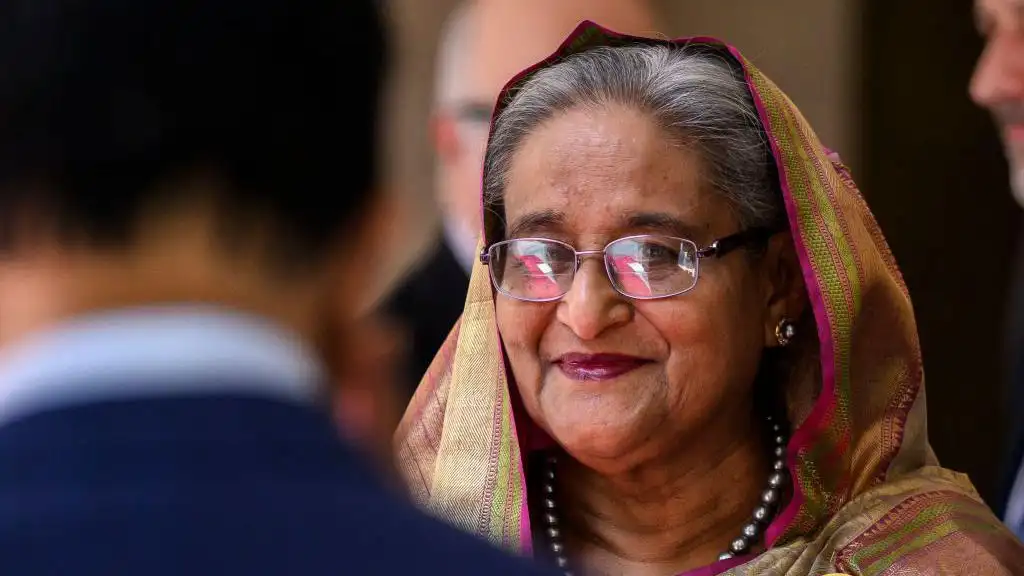
Former Bangladeshi Prime Minister Sheikh Hasina has launched a fierce on the country’s interim leadership, accusing Muhammad Yunus of authoritarianism and calling for a United Nations investigation into the unrest and political developments that followed her removal from power.
In an audio address played at a press conference at the Foreign Correspondents’ Club of South Asia in Delhi, Hasina urged the United Nations to conduct what she described as a new and truly impartial investigation into events over the past year. She said only a full clarification of the truth would allow Bangladesh to heal, reconcile, and move forward. The speech is being seen as one of her first major public statements since she was ousted from office.
Hasina accused Yunus, who now heads the interim government, of leading what she called a ous and fascist administration. She argued that democracy cannot be restored while an unelected government remains in power and warned that free and fair elections would be impossible under the current leadership.
According to the former prime minister, Bangladesh has entered an age of terror. She claimed that press freedom has been extinguished, religious minorities are facing sustained persecution, and law and order has broken down across the country. She called on the interim government to end what she described as daily acts of violence and lawlessness and to provide firm guarantees for the safety of religious minorities, women, and girls.
Hasina also accused the authorities of intimidating journalists, opposition parties, and members of her Awami League. She demanded that trust in the judicial system be restored and that political repression come to an end.
Her remarks come as Bangladesh prepares for general elections scheduled for February twelve, the first since her removal. Hasina resigned and fled to India in August twenty twenty four after weeks of widespread student led protests against her government, which had been in power for sixteen years. Following her departure, Nobel laureate economist Muhammad Yunus was appointed to lead the interim administration.
Hasina claimed that the unrest that led to her ouster had been carefully engineered by Yunus and his allies. She alleged that militant extremism had surged after the collapse of her government, spreading fear throughout the country. She further accused the interim leadership of plotting to hand over Bangladeshi territory and resources to foreign interests, calling it a betrayal of the nation.
In her message, Hasina appealed to the people of Bangladesh to reclaim what she described as the country’s independence and democracy by removing what she called a foreign serving puppet regime. She framed the current political struggle as a fight for national survival and sovereignty.
The interim government has not responded publicly to Hasina’s latest accusations. In May, it banned all activities of the Awami League, including its online platforms, under anti terrorism legislation. Hasina has previously condemned the ban as unjust and warned that it could undermine the credibility of the elections. She has also cautioned that millions of her supporters may boycott the vote if her party is barred from participation.
In November, Bangladesh’s International Crimes Tribunal sentenced Hasina to death for crimes against humanity related to the deadly crackdown on protesters in twenty twenty four. As the election approaches, her renewed intervention adds another layer of tension to an already deeply polarized political landscape.












Is Sheikh Hasinas accusation valid or just a political tactic? UN probe crucial or interference? Share your thoughts!
Is Sheikh Hasina justified in accusing the interim leader of fascism? Should the UN intervene in Bangladesh elections? Lets discuss!
Is Sheikh Hasinas accusation justified, or is it a strategic move ahead of the Bangladesh elections? Lets discuss!
Do you think Sheikh Hasinas accusations are valid or just a political tactic? Lets discuss! 🔍🤔
Interesting how accusations fly in politics. Curious to see if UN will actually investigate. What do you all think?
I dont know about you guys, but calling the interim leader a fascist seems a bit extreme. What do you think?
I find it interesting how Sheikh Hasina is bringing up fascism accusations. Do you think this will impact the upcoming Bangladesh elections?
Isnt it ironic how politicians accuse each other of fascism? Maybe they should focus on real issues.