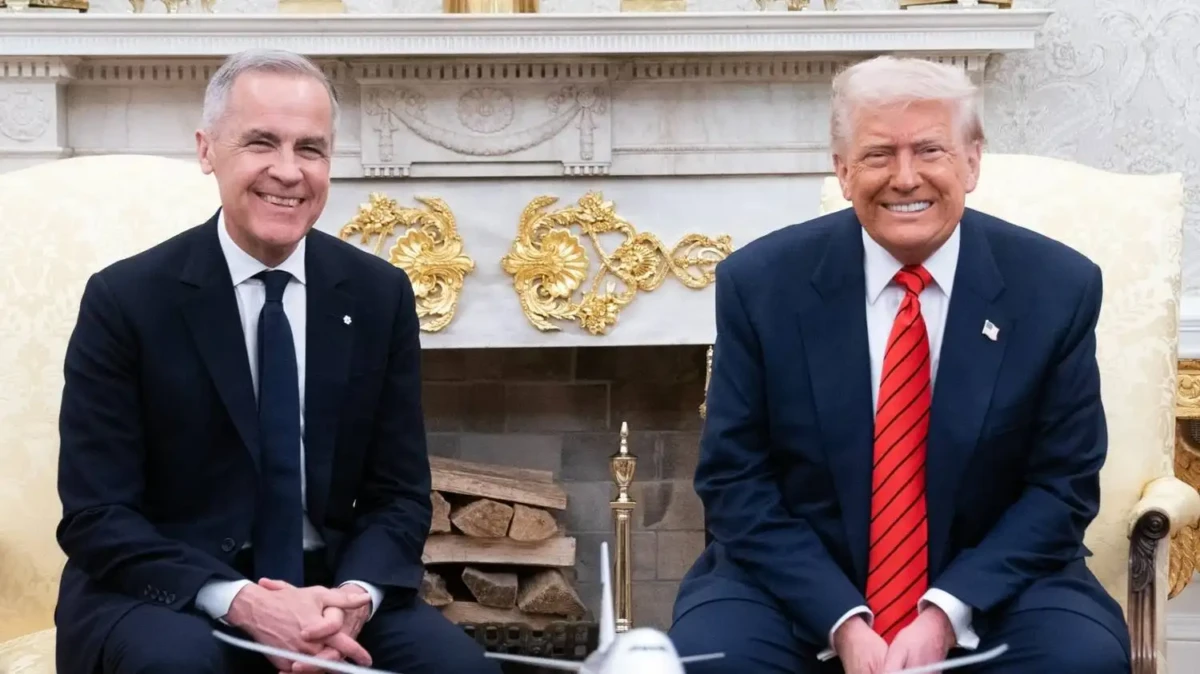
The relationship between the United States and Canada faced a new strain after the American president withdrew an invitation previously extended to Canada to join an international peace initiative. The decision came shortly after a speech by the Canadian prime minister at a global economic gathering, where he criticized the way powerful nations use economic influence and trade measures to control other countries.
The peace initiative was designed as a high level group of global leaders tasked with addressing major international conflicts. Canada had initially been invited to participate and had signaled its readiness to accept the offer. However, the situation ced rapidly following the prime minister’s remarks, which highlighted concerns about economic dominance and the growing use of tariffs and trade policies as political tools.
During his speech, the Canadian leader emphasized that the era of a rigid global order based on elished rules was coming to an end. He argued that countries with moderate influence on the world stage could work together to protect themselves from being unfairly treated by stronger powers. His words resonated strongly with the aunce and were met with significant approval.
The American president responded sharply, expressing dissatisfaction with the comments and questioning Canada’s position. He suggested that Canada owed much of its ility and prosperity to the United States and implied that the prime minister should show greater appreciation when making public statements about global power dynamics.
Shortly afterward, the invitation for Canada to join the peace initiative was officially withdrawn. The board had just been launched and was intended to play a major role in promoting international ility and supporting peace efforts in conflict regions. Participation in the initiative required significant financial contributions from member countries, reflecting the ambition and scale of the project.
Several countries from different regions of the world were confirmed as members of the board, while some traditional allies of the United States chose not to join at this stage. The involvement of the United Nations was framed as limited and tied specifically to broader peace efforts rather than full operational control.
This episode highlights deeper tensions in global politics, where disagreements over economic power, sovereignty, and international influence increasingly shape diplomatic relationships. It also reveals how quickly alliances can be tested when leaders openly challenge the structures that have long defined global cooperation.
As the world continues to shift toward a more multipolar balance of power, the incident between the United States and Canada serves as a reminder that even close partners can find themselves at odds when visions for the future of global order diverge.








Isnt it crazy how things escalate between neighbors? Wonder if Canada will start playing hockey with the US for control!
Are we witnessing the birth of a new rivalry between the US and Canada, or is this just a temporary spat? 🤔
Is Canada really a threat to the US or just a friendly neighbor causing drama? Lets discuss over poutine and maple syrup 🇨🇦🍁
Isnt it crazy how Canada and the US are getting all worked up over global power? Like, cant we all just get along? 🤷♂️
Is Canada really a threat to US global power? Seems like a friendly rivalry more than a serious conflict. Lets not overreact.
Honestly, I think Canada should stand up for itself more. Who knew they had such a strong stance on global power? Lets see where this goes!
Cant believe Canada and the US are beefing over global power! Who do you think will come out on top?
I think its kinda wild how the US and Canada are beefing over global power. Like, what even started this drama?
Who wouldve thought Canada and the US would be at odds over global power? Crazy times were living in, eh?
Is Canada really a threat to the US or just a friendly neighbor causing drama? Lets discuss over virtual coffee!
I think its wild how the US and Canada are beefing over global power. Like, cant we all just get along?
Isnt it crazy how the US and Canada are butting heads over global power? Who wouldve thought maple syrup could cause so much drama!