
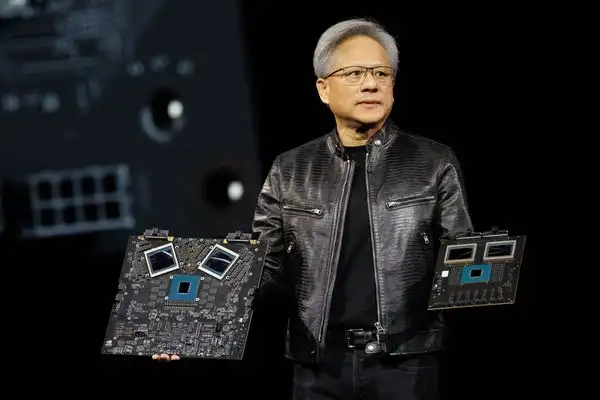
President Donald Trump announced that the U.S. would allow Nvidia to export its advanced H200 AI chips to China, a significant reversal from earlier restrictions on China’s access to such technologies.
This decision also applies to other semiconductor firms like AMD and Intel, with the government set to benefit from a 25% fee on sales to China. The H200 chip, while less advanced than Nvidia’s Blackwell and Rubin models, offers significant performance improvements over the previously allowed H20 chip.
The shift is seen as a strategic compromise, balancing national security concerns against the need for the U.S. to maintain its leadership in AI technology. In response to the announcement, Nvidia’s stock rose sharply, indicating investor optimism about revenue prospects from China, while AMD and Intel also noted positive movement in their stock prices.
However, this decision has sparked controversy among U.S. lawmakers. There are fears that exporting advanced AI chips could bolster China’s military and cyber capabilities, potentially compromising U.S. national security. In response, a bipartisan group of senators has introduced the SAFE Chips Act of 2025, which seeks to codify existing export restrictions on advanced AI technologies for 30 months.
Additionally, the U.S. Department of Justice has detained two individuals for allegedly attempting to smuggle Nvidia’s advanced chips to China, emphasizing ongoing concerns about unauthorized exports.
Overall, permitting the export of H200 chips signals a pivotal shift in U.S.-China trade relations with considerable implications for the global AI landscape.












Do you think this will lead to more competition in the AI chip market? Exciting times ahead! 💥🚀
Interesting move by Trump. Will this boost the tech industry or lead to potential risks in intellectual property? Lets discuss.
Is this a win-win or a risky move? Exciting times ahead for tech stocks! Lets see how it plays out.
Im not surprised by this move. Should we be concerned about the potential implications for national security? Lets discuss.
Wow, cant believe Trumps decision actually boosted Nvidia and AMD stocks! Is this a smart move or a risky gamble? Share your thoughts!