
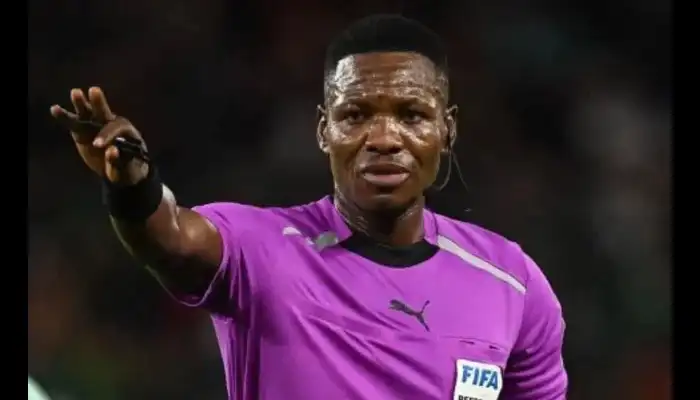
Nigerian football fans have sharply criticised Ghanaian referee Daniel Laryea following the Super Eagles’ semi-final loss to Morocco at the 2025 Africa Cup of Nations. Nigeria fell 4-2 on penalties after a goalless draw, with Samuel Chukwueze and Bruno Onyemaechi seeing their spot-kicks saved by Moroccan goalkeeper Yassine Bounou.
Fans’ anger largely centered on Laryea’s decisions during the match. Nigeria committed 29 fouls compared to Morocco’s 19, yet received two yellow cards while the hosts went unpunished. Many supporters perceived this as one-sided officiating, citing the Nigeria-Ghana football rivalry as a possible influence.
At a viewing centre in Lagos, fans voiced frustration over several contentious calls. Olakunle Okunbanjo said, “Obviously, he’s been biased. Looking at it, we all expect this home advantage. But it seems he’s been extra biased and has made so many wrong calls.” Bernard Daniel added, “Even during extra time, commentators were confused about his decision, especially the corner kick that was called a goal kick during the Victor Osimhen incident.”
On social media, fans vented further outrage. User Roweazy Zetarium called him “the worst referee in AFCON 26,” while another, Oby, wrote, “God punish that referee, but before God, men go first punish am!” Particular criticism focused on the yellow card shown to Calvin Bassey, which will see him miss the third-place play-off.
Laryea, a FIFA-listed referee since 2014, officiated his second fixture of the tournament. His experience includes the African Nations Championship, AFCON, and CAF Women’s Champions League. He was supported by assistant referees from South Africa, Lesotho, and Mozambique, with VAR duties overseen by officials from South Africa, Tunisia, and Kenya.
Despite Morocco’s strong performance, Nigerian fans insist that Laryea’s officiating unfairly influenced the outcome, reigniting debates about refereeing standards and neutrality in African football.





I think the referee might have had a bad day, but lets not be too harsh. Everyone makes mistakes!
I think the referees nationality shouldnt matter. Lets focus on the game, not where the ref is from.
I think the referee did a fair job. Mistakes happen in every game. Nigerian fans need to chill.
I think the referees decisions were fair. We cant always blame the officiating when our team doesnt perform well.
I dont get why everyones mad at the ref. Maybe the Super Eagles just didnt play well? Just sayin.
I think the referee did a fair job. Fans need to chill and accept the games outcome. Its just sports, lets move on!
I think its unfair to blame the referee for the games outcome. Lets focus on the players performance instead.
I think its unfair to blame the referee for the loss. The Super Eagles should focus on improving their game instead.
I think its unfair to blame the referee for everything. Lets give credit to the players performance too!