
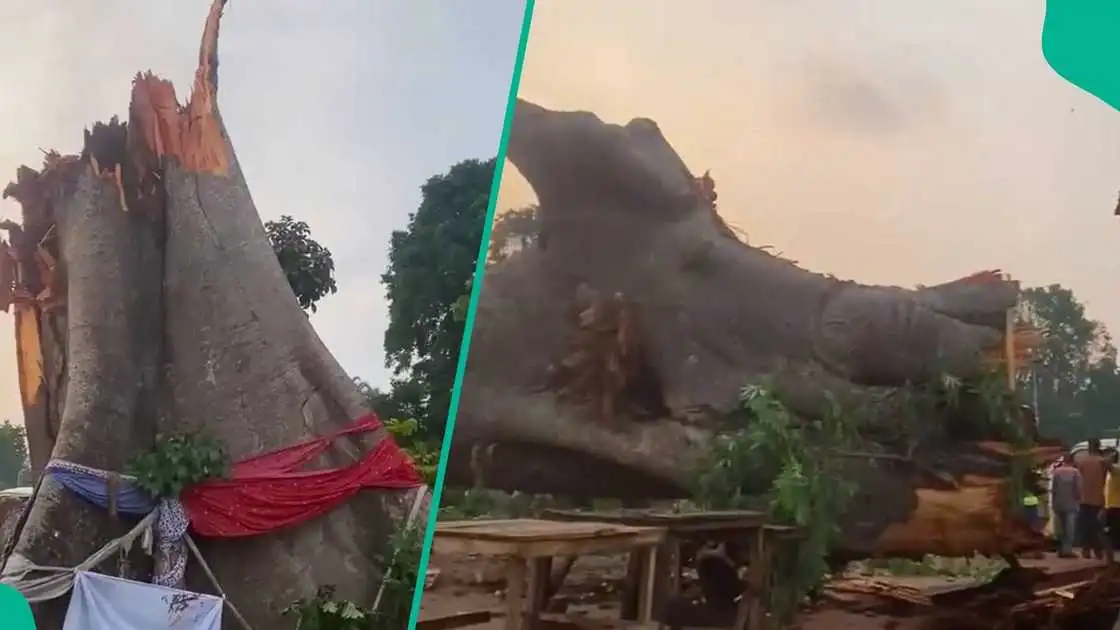
A devastating incident in Awhum community, Udi LGA, Enugu State, on February 17, 2026, has highlighted the deadly risks posed by aging trees near populated areas. A revered ancestral tree, Ukwu Akpu Awhum, over 100 years old, collapsed during heavy rainfall and strong winds, crushing two vehicles and killing 11 people, mostly women passengers. Four survivors were rescued and hospitalised.
The tree fell around 8:45 pm at a busy market square and bus stop, striking a Toyota Hiace bus and a Sienna minivan carrying passengers from Enugu’s Old Park to nearby villages. Eyewitnesses and police reports indicated internal decay weakened the tree, worsened by the storm. Locals mourned both human loss and the cultural significance of the tree.
Dr. Nnimmo Bassey, Founder of Health of Mother Earth Foundation, urged authorities to balance tree preservation with public safety. He said, “A tree that is more than a hundred years old requires monitoring. Branches, termites, or internal decay must be checked to ensure people are safe. If maintained properly, disasters like this could be prevented.”
Professor of Anthropology, Aderemi Suleiman Ajala, emphasized that tree age and condition are critical factors, noting that in developed countries, old trees are monitored, trimmed, or replaced before they pose risks. He added that cultural significance of the tree must be documented but safety must remain a priority.
Globally, falling trees are a documented hazard. The US recorded 1.45 deaths per million people annually from wind-induced tree failures (1995–2007), while the UK reported roughly 6.4 deaths yearly (1999–2008). Environmentalists stress that while old trees provide carbon sequestration and biodiversity benefits, unchecked growth near homes or roads increases danger, particularly during storms.
Experts recommend regular inspections by arborists, strategic pruning, installing supports for large trees, and replacing hazardous trees with resilient species. Public education on tree risks and climate-driven weather hazards can also prevent tragedies.
The Awhum disaster underscores the need for a balance between preserving nature and protecting human life, prompting urgent review of tree management policies in Nigerian communities.











Leave a comment