
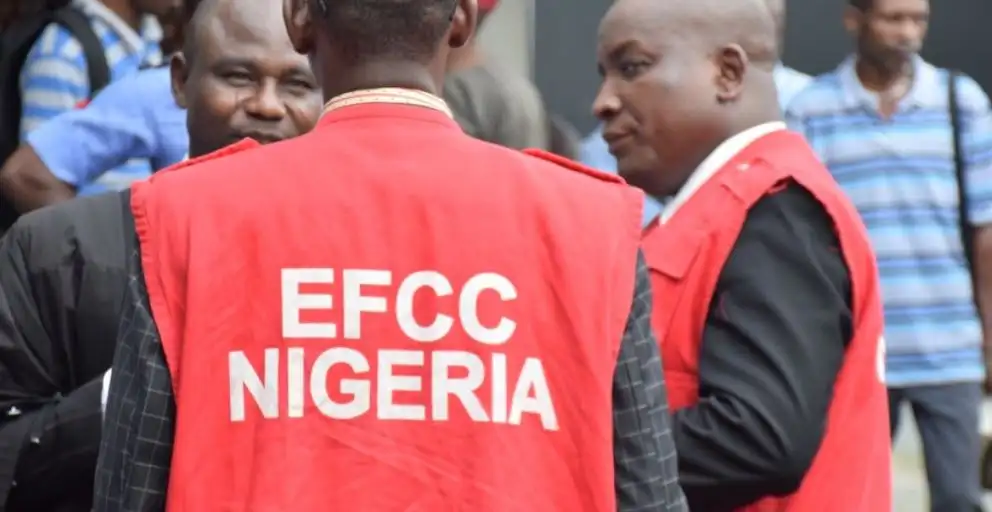
The Economic and Financial Crimes Commission (EFCC) has revealed systemic lapses in Nigeria’s financial sector, disclosing that commercial banks, fintech companies, and microfinance banks facilitated the movement of N162 billion in cryptocurrency transactions and N18.7 billion in fraud proceeds without proper due diligence. The fraudulent activities affected over 900,000 Nigerians.
Speaking at a media briefing in Abuja, EFCC Director of Public Affairs, Wilson Uwujaren, said the Commission’s investigations uncovered major schemes orchestrated by foreign nationals using compromised accounts and deceptive payment systems. One syndicate, operating a fake airline ticket discount platform, defrauded more than 700 victims, siphoning N651.1 million. The EFCC has recovered and returned N33.6 million to affected individuals.
A larger investment scam involved nine companies promising bogus investment packages, defrauding over 900,000 Nigerians of N18.1 billion. Uwujaren explained that some financial institutions compromised standard procedures, allowing fraudsters to convert illicit proceeds into cryptocurrency and transfer them offshore. Alarmingly, one bank allowed a single customer to operate 960 accounts used exclusively for fraudulent purposes.
Uwujaren warned that such negligence would no longer be tolerated. “Deposit Money Banks, Fintechs, Microfinance Banks found to be aiding and abetting fraudsters should be suspended and referred to the EFCC for investigation and possible prosecution,” he said.
The Commission urged regulatory authorities to ensure full compliance with Know Your Customer (KYC) and Customer Due Diligence (CDD) requirements to prevent further economic losses. Uwujaren emphasized that financial institutions must strengthen internal controls to curb illicit transactions, protect consumers, and safeguard the nation’s economy.
The EFCC continues efforts to apprehend foreign suspects linked to these schemes, while prosecuting local accomplices already in custody.











I cant believe the audacity of these banks and fintechs! They need to be held accountable for aiding in such massive fraud.
I cant believe the audacity of these banks and fintechs! They need to be held accountable for enabling such massive fraud.
Why isnt there more accountability for these banks and fintechs? Its outrageous how they enable such massive fraud.
I cant believe these banks and fintechs are involved in such massive fraud! How can we trust them with our money now?
I find it hard to believe banks and fintechs are involved in fraud. Is this just a case of a few bad apples, or a systemic issue?
I find it hard to believe that banks and fintechs are involved in such massive fraud. Whats happening to our financial system?
I cant believe the audacity of these banks and fintechs facilitating such huge fraudulent transactions. Disgusting!
I cant believe how these banks and fintechs are getting away with facilitating such massive fraudulent transactions. Soing needs to ce!