
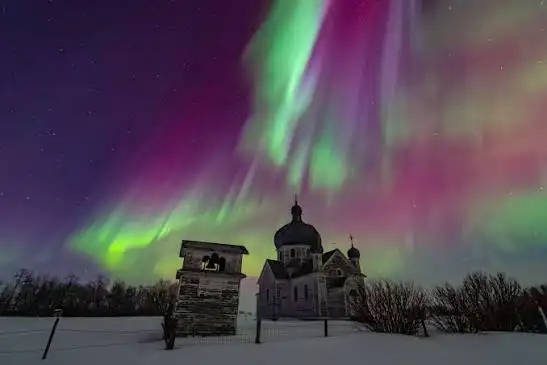
Communities across various regions are closely monitoring unusual aurora activity as heightened solar energy interacts with Earth’s magnetosphere. Scientists report that recent solar emissions have increased the likelihood of visible light displays beyond typical polar zones. Observers are sharing real time updates, creating widespread interest among both amateur skywatchers and professional researchers studying atmospheric and space phenomena.
Experts explain that these displays are linked to bursts of charged particles from the Sun that travel through space and interact with Earth’s magnetic field. When these particles collide with gases in the upper atmosphere, they produce luminous patterns commonly known as auroras. The intensity and visibility depend on the strength of solar activity and local atmospheric conditions at any given time.
Space weather monitoring agencies have issued alerts encouraging observation in regions where visibility may extend further than usual. These advisories are based on continuous tracking of solar events, including coronal mass ejections and solar flares. Researchers emphasize that while the displays are visually striking, they also provide valuable data for understanding solar behavior and its broader effects.
Interest in aurora viewing has expanded through online communities where enthusiasts share forecasts, photography tips, and live experiences. Social platforms have become hubs for coordination, enabling individuals to locate optimal viewing spots. This digital engagement has contributed to a growing appreciation of natural phenomena, blending scientific curiosity with cultural fascination and community participation.
Scientists also note that increased solar activity can have practical implications beyond visual displays. It may influence satellite operations, communication systems, and navigation technologies. Monitoring these effects is critical for minimizing potential disruptions, particularly as reliance on space based infrastructure continues to grow in both commercial and governmental sectors worldwide.
Educational institutions and science organizations are using the heightened interest to promote awareness of space weather and its relevance to everyday life. Public outreach initiatives are highlighting the connections between solar cycles, geomagnetic activity, and technological systems. This approach aims to deepen public understanding while encouraging interest in scientific research and observation.
As solar activity continues to evolve, experts anticipate ongoing opportunities for aurora observation in unexpected locations. The phenomenon serves as a reminder of the dynamic relationship between Earth and the Sun. Communities remain engaged, watching the skies with anticipation as science and spectacle converge in a shared global experience of natural wonder.










Leave a comment