
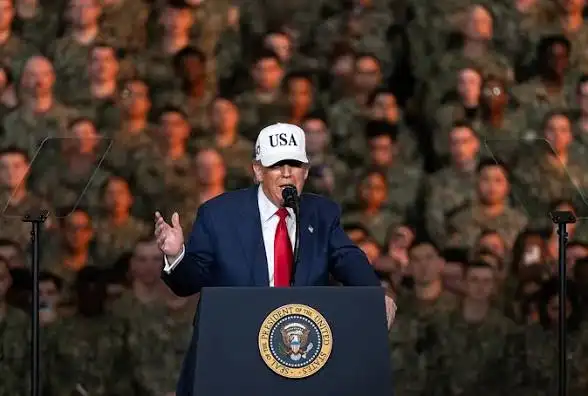
United States President Donald Trump has approved a substantial increase in war related funding while making clear that American ground troops will not be deployed, a decision that reflects a strategic attempt to balance military readiness with domestic and international concerns about deeper involvement in the intensifying confrontation with Iran and its regional implications.
Officials in Washington indicated that the funding package is intended to strengthen air and naval capabilities, enhance intelligence operations, and support allied forces, while avoiding the political and logistical challenges associated with large scale troop deployments, signaling a continuation of policies that prioritize remote engagement and technological advantage in modern conflict scenarios.
Lawmakers in Congress have expressed mixed reactions to the move, with some supporting the emphasis on preparedness and deterrence, while others question the long term financial and strategic implications, highlighting ongoing debates about the scope of U.S. involvement and the potential risks of escalation in an already volatile geopolitical environment shaped by competing regional interests.
Military analysts suggest that the approach allows the United States to maintain influence without committing to prolonged ground operations, which have historically carried significant costs and uncertainties, while still providing reassurance to allies concerned about security threats, particularly in regions where tensions have escalated rapidly and require coordinated responses across multiple domains.
International observers note that the decision may also be aimed at sending a signal to adversaries, demonstrating capability and resolve without crossing thresholds that could trigger wider confrontation, as diplomatic channels remain active and efforts continue to manage perceptions and reduce the likelihood of miscalculation among various actors engaged in the unfolding crisis.
Economic considerations are also central to the discussion, as increased defense spending can have ripple effects on national budgets and global markets, with investors monitoring how such allocations might influence fiscal policy, industrial production, and broader economic trends, especially in a context where energy prices and supply chains are already under pressure.
The announcement underscores the complexity of modern conflict management, where governments seek to project strength while limiting exposure, balancing domestic expectations with international responsibilities, and navigating a landscape where decisions made in one region can have far reaching consequences for global security, economic ility, and diplomatic relations across interconnected systems worldwide.








Leave a comment