
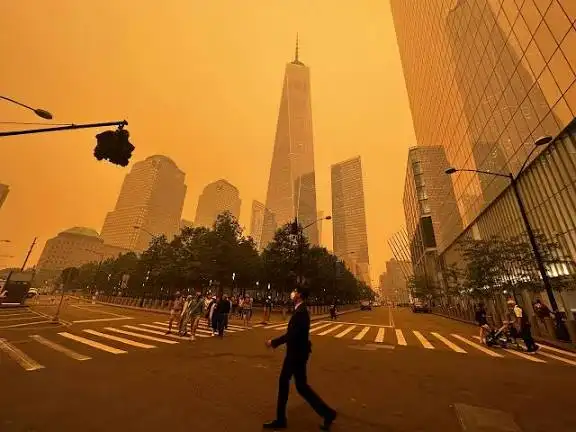
Officials have placed New York City among the most polluted major urban centers in recent days after elevated particulate matter levels triggered an official air quality advisory, prompting health warnings and precautionary measures across the metropolitan area.
Environmental monitoring agencies reported a sharp increase in fine particulate pollution known as PM two point five, which can penetrate deep into the lungs and enter the bloodstream. Authorities attributed the spike to a combination of regional atmospheric conditions, vehicle emissions, and possible contributions from distant wildfire smoke transported by shifting wind patterns.
City officials advised residents, particularly children, the elderly, and individuals with respiratory conditions, to limit prolonged outdoor activity. Public health departments recommended the use of protective masks for vulnerable groups and encouraged schools and employers to adjust outdoor schedules where possible.
Air quality indices climbed into unhealthy ranges in several boroughs, leading to alerts circulated through mobile applications and public broadcast channels. Environmental experts emphasized that short term exposure to high particulate concentrations can exacerbate asthma and other respiratory illnesses, while prolonged exposure is associated with broader cardiovascular risks.
Municipal agencies have activated response protocols aimed at mitigating pollution sources. Traffic management measures and advisories encouraging reduced vehicle use were issued. Officials also called on residents to minimize activities that contribute to air pollution, such as burning waste or excessive energy consumption during peak periods.
The advisory underscores ongoing challenges faced by densely populated cities striving to balance economic activity with environmental sustainability. While New York City has made significant progress in reducing emissions over past decades, episodic pollution spikes continue to test urban resilience.
Climate scientists note that extreme weather patterns can intensify air quality issues by trapping pollutants near the surface. Temperature inversions and stagnant air masses can prevent dispersion, allowing contaminants to accumulate. Authorities are closely monitoring meteorological forecasts to determine when conditions may improve.
Public health experts stress that transparent communication is essential during air quality events. Officials have urged residents to follow guidance issued by city and state environmental departments and to seek medical attention if symptoms such as difficulty breathing or chest discomfort arise.
As monitoring continues, the advisory highlights the broader intersection of urban planning, climate dynamics, and public health. Policymakers face growing pressure to accelerate clean energy transitions and strengthen pollution control strategies to safeguard residents in one of the world’s most influential cities.












Leave a comment