
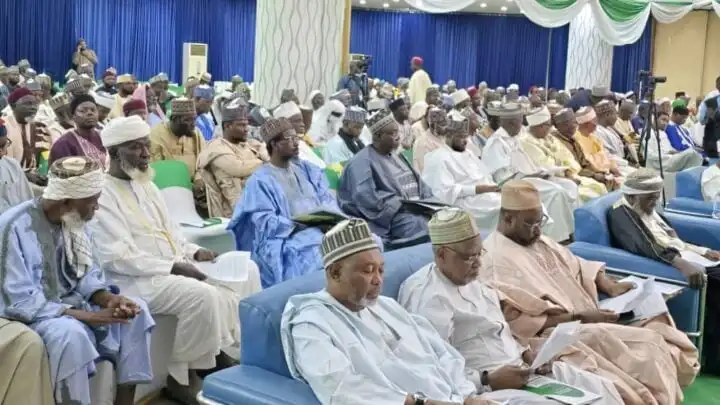
ABUJA – The Supreme Council for Shari’ah in Nigeria has warned that it will not recognise or legitimise elections conducted under compromised conditions, stressing the need to protect the credibility of Nigeria’s democratic process ahead of the 2027 general elections.
The Council made this position known at its Annual Pre-Ramadan Lecture and General Assembly in Abuja, attended by Islamic scholars, traditional leaders, professionals, and representatives of Islamic organisations. Sheikh Bashir Aliyu Umar, President of the Council, and Madakin Zazzau, Mallam Muhammadu Munir Ja’afaru, delivered keynote remarks.
Sheikh Umar emphasised that public confidence in institutions, especially the Independent National Electoral Commission (INEC), is vital for national ility, noting that democratic legitimacy cannot exist without integrity. “The Ummah will not recognise or legitimise any election presided over by a character with questionable integrity, as democratic credibility must never be compromised,” he said.
The Council also highlighted the broader challenges facing Nigeria, including worsening insecurity, economic hardship, unemployment, and rising costs of living. Muslim communities, it noted, have been disproportionately affected by ongoing violence and terrorism, while condemning misleading narratives around religious conflict.
On governance, the Council criticised aspects of fiscal policy, budget implementation, and federal appointments, urging equitable, humane, and socially responsible policies. It reaffirmed the constitutional right of Muslims to implement Shari’ah, stressing peaceful coexistence and moral responsibility.
The Council also condemned the war in Gaza as genocide and called for justice and humanitarian access for Palestinians. Mallam Ja’afaru described the Shariah Council as a principled and courageous voice for the Muslim Ummah, promoting unity, justice, and national ility.
As Ramadan approaches, the Council urged Islamic scholars to use religious teachings to foster ethical leadership, responsible civic engagement, and national renewal.




I dont get why the Shariah Council is getting involved in politics. Shouldnt they focus on religious matters instead?
Interesting perspective from the Shariah Council. Do you think their call for national renewal will have any impact on the upcoming elections?
Do we really need religious councils influencing elections? What about separation of church and state? Just a thought.
Do you think the Shariah Councils warning on compromised elections is a necessary wake-up call or an overreaction? Lets discuss!
Im not convinced. How can a Shariah Council dictate national renewal and elections? Seems like a power grab to me.
I dont see why a Shariah Council should interfere in elections. Separation of religion and state, anyone?
I dont know about you guys, but I think the Shariah Council is overstepping their bounds. Who are they to dictate national renewal?